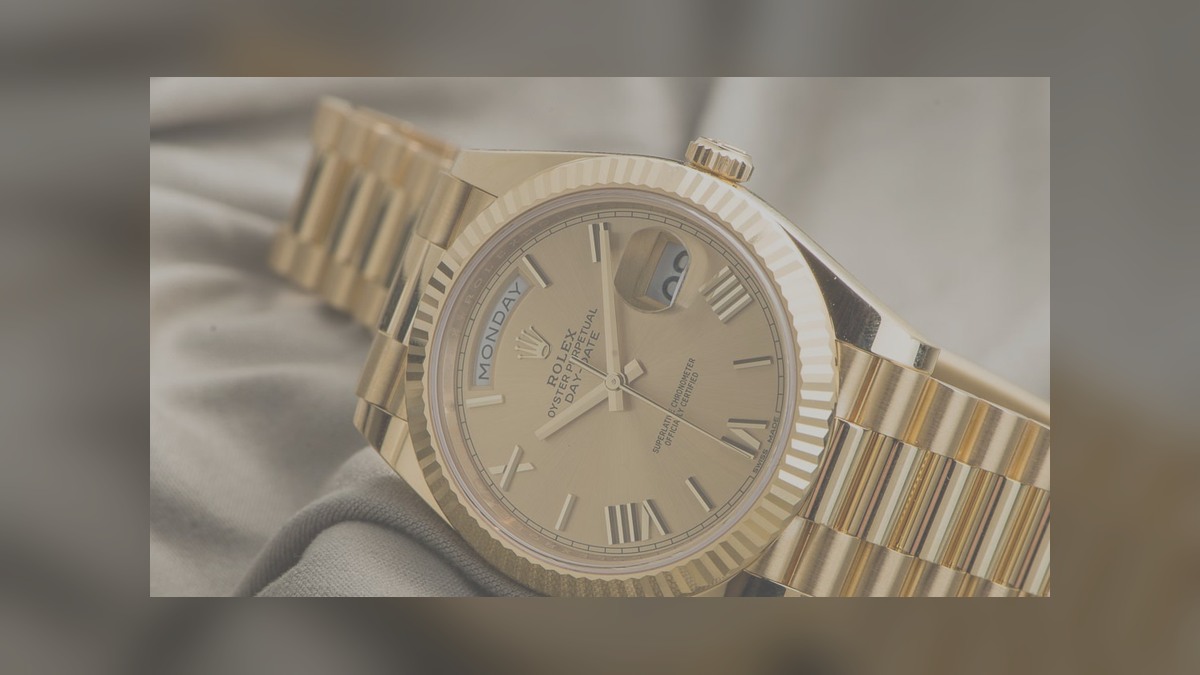
Rolex President Bracelet Replica Guide
A component-level guide to President-style bracelet geometry, end-link fit, articulation, clasp operation, precious-metal references and replica finishing.
A component-level guide to President-style bracelet geometry, end-link fit, articulation, clasp operation, precious-metal references and replica finishing.
On a Day-Date, the bracelet controls the transition from case to wrist and exposes machining, finishing and coating quality over dozens of moving surfaces.
Editorial review: . Genuine Rolex specifications are used only as a reference baseline; replica construction, materials and water resistance must be verified separately.
Rolex states that the President bracelet was created in 1956 for the Day-Date and uses semi-circular three-piece links. In current genuine production it is made from 18 ct gold or 950 platinum; modern versions use a concealed folding Crownclasp, and Rolex describes ceramic inserts inside the links on contemporary bracelets to improve longevity and flexibility.
Official reference: Rolex President bracelet.
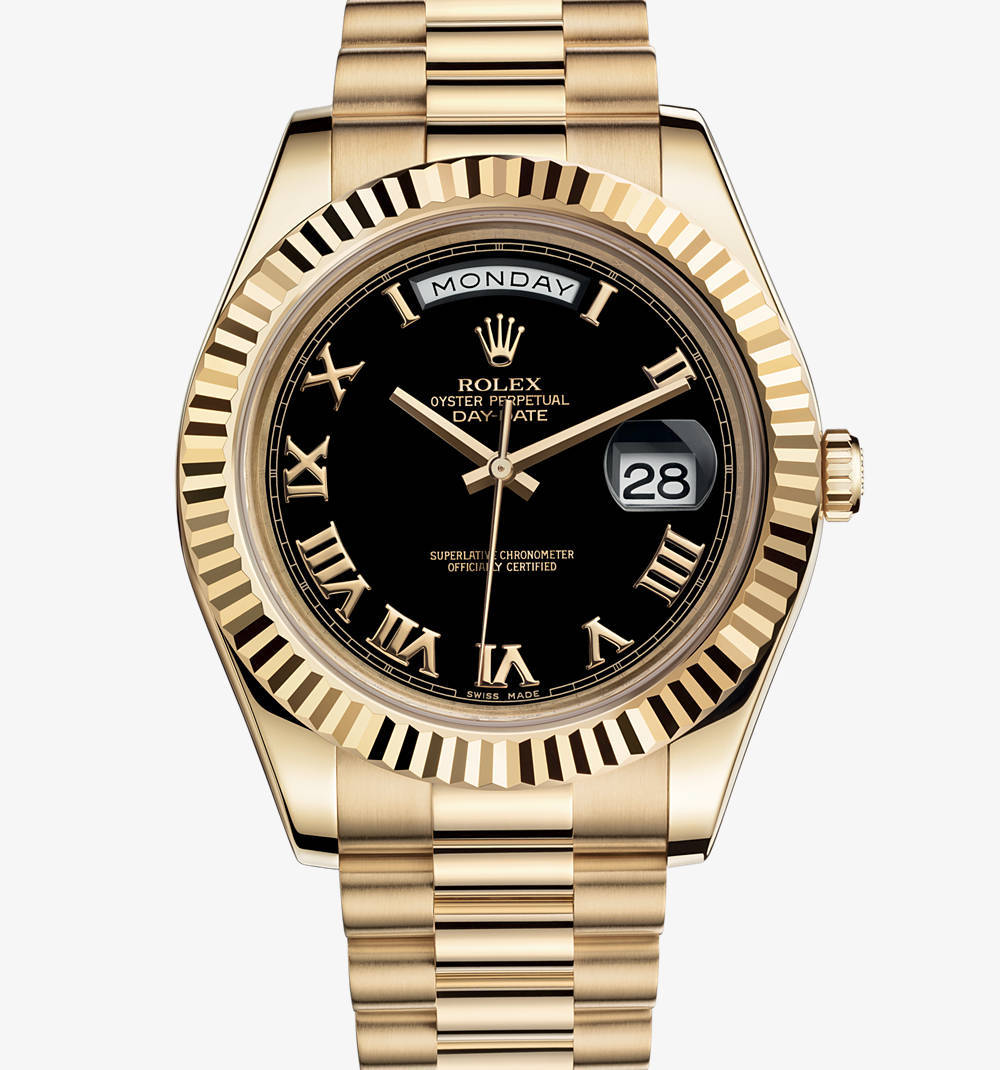
Photograph the watch straight on and at a shallow three-quarter angle. Look for gaps between end link and case, a vertical step where the bracelet sits too low, inconsistent curvature and a first movable link that binds against the case.
A bracelet can feel heavy yet still have weak end links. Weight is therefore not a substitute for fit. On a 36 mm watch the transition should look proportionally restrained; on a 40 mm watch the first links can be larger but should still follow the case rather than appearing bolted on.
Seller wrist photos keep every link under tension and can conceal stiffness. Ask for an image or short video with the watch held by the case so the bracelet hangs freely. Smooth articulation should be visible without individual links locking at awkward angles.
Check whether centre and outer sections maintain consistent shape and spacing. On plated versions, flexing the bracelet also exposes inner surfaces that may receive less complete coating than the top faces.
A crown emblem on a closed clasp says little about the folding mechanism. Ask to see the clasp open, the hinge points, interior finish and the action of closing it. The clasp should engage predictably without excessive force or a loose final position.
Examine edges that touch skin. Sharp finishing can become uncomfortable even when the bracelet looks polished from above. Also inspect screw or pin access because future sizing and service depend on hardware quality.
Surface treatment is most informative at friction points: inside the clasp, link sides, screw recesses and the underside near the wrist. Ask whether the bracelet is PVD-coated, plated or treated by another process, and whether the case and bracelet were finished together.
A consistent colour in a stock photo does not establish coating durability. Buyers who care about long-term appearance should ask how refinishing is handled and whether replacement links are available.
Genuine Day-Date bracelets are precious metal and therefore have a different density profile from many replica constructions. But replica weight can be manipulated through thick links, inserts or different base metals. Weight can flag an obviously light build, yet it cannot prove solid gold or platinum.
A bracelet may look convincing but wear poorly if the minimum removable-link configuration is still too large, if the clasp sits off-centre, or if stiff links prevent the bracelet from wrapping evenly around the wrist. Ask for the approximate bracelet circumference and number of removable links when sizing is critical.
For case-specific fit, see Day-Date 36 and Day-Date 40.
Modern replica bracelets are often marketed by weight and whether links feel “solid.” Those qualities can improve perceived substance, but tolerance between components determines whether the bracelet moves smoothly. Excessive side play creates rattling; overly tight links can bind and concentrate wear on coating edges.
Ask how links are retained and whether replacement screws or pins are supplied. Poorly machined screw heads can strip during sizing. Threads should engage smoothly and should not require improvised force. If thread-locking compound is used, sizing should be performed carefully so future service remains possible.
Removing all links from one side can pull the clasp away from the centre of the wrist. A balanced bracelet usually distributes removable links so the clasp sits naturally. Ask the seller or watchmaker to size both sides rather than simply removing the easiest links.
After use, coating failure often appears first at link corners, clasp edges and the surfaces that rub together. Micro-scratches are normal on polished finishes; the more important question for a coated replica is whether scratching exposes a sharply different base colour.
A solid stainless-steel bracelet can often tolerate polishing or brushing that would remove a thin surface coating. Before refinishing a gold-tone replica, establish what treatment was applied. Aggressive polishing can make the appearance worse by cutting through the surface layer.
Any multi-link metal bracelet makes some noise when moved. A sharp click from one link, grinding near the clasp or a screw backing out is more concerning than a general metallic sound. Inspect the exact point where noise originates rather than using “silent bracelet” as an unrealistic quality target.
Functional clearance is necessary, but visible uneven gaps or one end link sitting materially lower than the other can indicate poor fit.
It matches the visual language of the genuine modern President bracelet, but execution matters. A well-made conventional clasp can be more durable than a poorly engineered concealed one.
Sometimes, but conventional polishing can remove the surface layer. Refinishing depends on coating type and remaining thickness, so ask before attempting it.