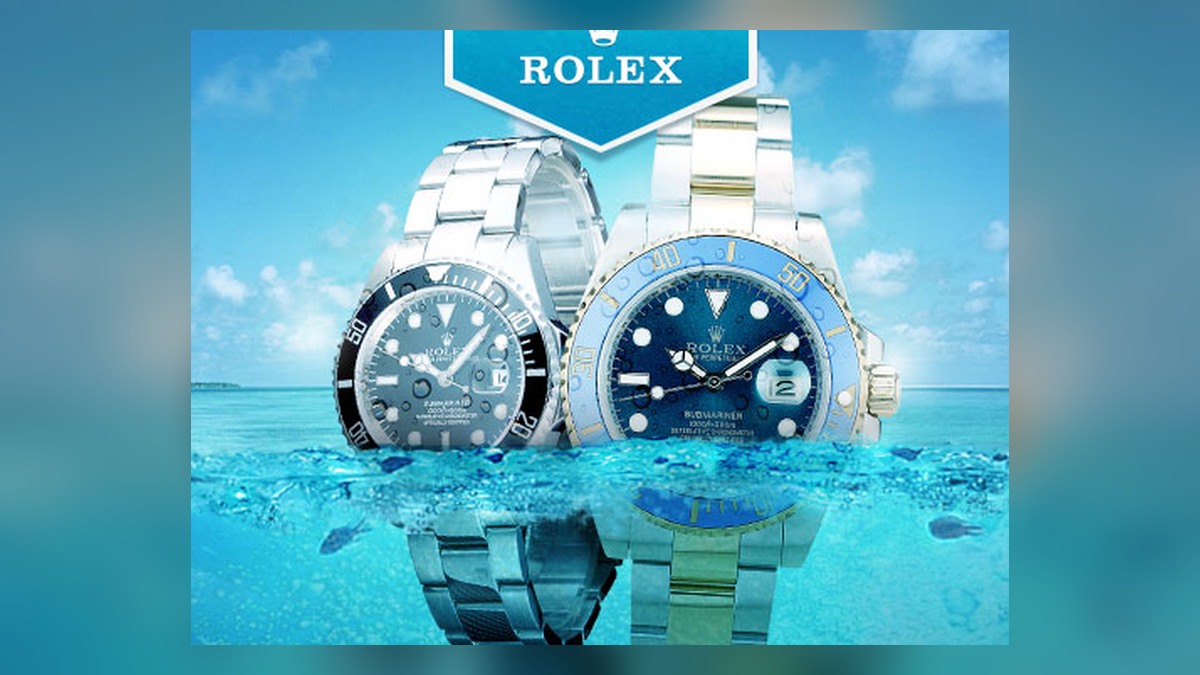
Rolex Submariner Replica Guide
A detailed Submariner reference covering 41 mm case geometry, bezel execution, dial and lume, Date vs no-date architecture, movement claims, bracelet function and pressure-test evidence.
A detailed Submariner reference covering 41 mm case geometry, bezel execution, dial and lume, Date vs no-date architecture, movement claims, bracelet function and pressure-test evidence.
The Submariner is easier to recognize than to reproduce well. Its apparent simplicity exposes errors in case geometry, bezel alignment, dial spacing, bracelet construction and water-resistance claims.
Editorial review: . Genuine specifications were checked against Rolex and movement-maker documentation where available.
Rolex describes the current Submariner family as 41 mm dive watches with an Oyster case rated to 300 metres, a unidirectional 60-minute graduated Cerachrom bezel and Chromalight display. The no-date Submariner 124060 uses calibre 3230; the Submariner Date 126610 uses calibre 3235 and adds the date/Cyclops system. Those genuine specifications are useful baselines, but they must not be copied onto a replica product page as if the replica had passed the same testing.
Official sources: Rolex Submariner features, Rolex Submariner 124060, and Rolex Submariner technical overview.
Do not ask whether a replica “looks like a Submariner” in a catalogue photo. Ask whether each functional area—case, bezel, dial, crystal, bracelet, movement and sealing—has evidence that supports the seller’s claim.

| Reference point | Submariner 124060 | Submariner Date 126610 | Replica implication |
|---|---|---|---|
| Diameter | 41 mm | 41 mm | Case diameter alone cannot distinguish build quality. |
| Genuine movement | Calibre 3230 | Calibre 3235 | Date model requires correct date placement and magnifier integration. |
| Date/Cyclops | None | Date at 3 + Cyclops | No-date dial is visually cleaner; Date version creates more alignment checks. |
| Genuine water resistance | 300 m / 1,000 ft | Replica requires separate pressure-test evidence. | |
| Bezel | Unidirectional 60-minute graduated ceramic insert | Inspect alignment, printing, lume pip and action rather than colour alone. | |
Front photographs can hide thickness. Ask for side and three-quarter images showing lug shape, crown-guard profile and the transition from brushed upper surfaces to polished case sides. Generic cases often look too thick because these planes are simplified.
A taller case back can be used to accommodate a different movement. This may be practical, but it changes how the watch sits on the wrist. Side-profile evidence is therefore especially useful when a seller claims near-genuine dimensions.
The inner wall between crystal and dial can appear too deep or too shallow if movement height, crystal position or dial spacing differs. This is one reason a replica can look convincing in a straight-on photo yet feel visually “off” in person.
The current genuine Submariner uses a unidirectional 60-minute graduated bezel with a ceramic Cerachrom insert. A replica comparison should consider at least five independent details.
Do not assume that “ceramic bezel” equals genuine-like construction. Ceramic describes one material component; it says nothing about click mechanism, dimensions, engraving quality or alignment.
The Submariner dial relies on a simple set of circles, rectangles and a triangle. Rolex’s own technical material emphasizes legibility and Chromalight. Because the geometry is repetitive, a crooked marker or inconsistent lume plot stands out.
Check equal spacing from the minute track, consistent metal surrounds and whether the 6 and 9 markers sit level. Macro images should be taken without extreme sharpening, which can create artificial edges around print and lume.
Inspect relative lengths and the distance between the Mercedes-style hour hand, minute hand and indices. Also check whether hand edges are clean and whether the stack height looks excessive.
A bright charge photo is not enough. Better evidence includes how evenly each marker glows and how quickly different components fade relative to one another. Sellers often expose watches to strong light immediately before photographing them, which says little about duration.
The Date version adds the same kind of stacked alignment problem seen on a Datejust: date wheel, aperture, crystal and Cyclops all need to agree.
For a no-date Submariner replica, removing the date mechanism simplifies the dial visually but does not guarantee a better case, bezel or movement.
Rolex’s current Submariner uses an Oyster bracelet with an Oysterlock safety clasp and Glidelock extension system. A replica clasp may copy the appearance while using a different internal mechanism.
Bracelet screws, link edges and clasp interiors are also useful places to inspect finishing because they are less likely to be hidden by reflections than the polished case side.
The genuine no-date Submariner 124060 uses calibre 3230; the genuine Submariner Date 126610 uses calibre 3235. Both current Rolex movements are specified with about 70 hours of power reserve and -2/+2 seconds/day after casing. Replica movements should be evaluated on their own published or measured performance.
| Movement | Published function | Frequency | Approx. running time | Submariner use |
|---|---|---|---|---|
| MIYOTA 8215 | 3 hands + date | 21,600 vph | 42 h | Functionally suits a date display; case height and date alignment still depend on integration. |
| MIYOTA 9015 | 3 hands + date | 28,800 vph | 42 h | Higher beat and thinner published profile; not equivalent to a Rolex 3235. |
| “Clone 3230/3235” | Depends on actual architecture | Depends | Depends | Ask for exact calibre photos, crown sequence, measured reserve and service/parts information. |
For a no-date build, a date-capable movement can still be used with the date display hidden, but the crown may retain an unused position depending on architecture. If that detail matters to you, ask how the crown behaves before buying.
Rolex states that the genuine current Submariner and Submariner Date are waterproof to 300 metres. That number is tied to Rolex case design, Triplock crown system, seals, assembly and testing. It is not a visual specification.
A replica can have a screw-down crown and still fail a modest pressure test because of gasket condition, crystal fit, case-tube tolerances or assembly. If the watch will be used around water, ask for a dry or wet pressure-test result on the actual unit. After the case is opened for service, testing should be repeated.
Pressure resistance can vary between individual watches from the same source. Unit-level evidence is stronger than a generic seller promise.
Rolex describes its steel as Oystersteel from the 904L family, and that term has become common in replica marketing. Even if a replica uses a 904L-family alloy, the number does not tell you machining quality, polishing, brushing, bracelet tolerances, clasp construction or corrosion performance after assembly.
Ask whether the material claim applies to the case, bracelet and clasp or only one component. Then inspect the finishing itself: brushing direction on the lugs and bracelet, polish on case sides, edge definition and consistency between replacement or separately manufactured parts.
The Submariner mixes broad brushed surfaces with polished case sides. If edges are over-polished, the case can look rounded and soft; if brushing is coarse, the watch can look industrial rather than deliberate. These differences are easier to judge from angled diffuse-light photos than from black-background glamour shots.
A deep buying guide should consider what happens after the first week. Bezel mechanisms collect dirt, bracelet screws can loosen, gaskets age and automatic movements eventually need service. A replica with a common, identifiable movement may be easier for an independent watchmaker to maintain than a highly decorated proprietary clone with scarce parts.
Water-resistance claims should also be treated as temporary test results rather than permanent properties. Any case opening, crown-tube work, crystal replacement or gasket change can alter sealing. If water use matters, periodic pressure testing is a more responsible practice than relying forever on the result supplied when the watch was new.
Alignment and geometry are usually more reliable visual checks because colour changes significantly with lighting and camera processing. Bezel action also requires video rather than a still photograph.
No. It identifies an insert material, not the quality of the bezel mechanism, engraving, lume marker, dimensions or fit.
It removes the date wheel, aperture and Cyclops alignment problem, but case, dial, bezel, bracelet and water-resistance quality remain independent challenges.
Functionally it provides three hands and date, so it can be adapted. The question is whether the case, stem height, date position and thickness are engineered well around it.
No. A screw-down crown is only one part of sealing. Ask for a pressure test on the individual watch.
Prioritize a straight-on dial/bezel shot, a side profile, a crown-guard view, an end-link/clasp image and—on the Date model—a close-up of the date/Cyclops. Then ask for video if the listing makes functional claims about bezel action or water resistance.