Rolex Day-Date 40 Replica Guide
A modern 40 mm Day-Date reference focused on case geometry, calendar placement, 3255-style movement claims, bracelet integration, materials and actual-watch QC.
A modern 40 mm Day-Date reference focused on case geometry, calendar placement, 3255-style movement claims, bracelet integration, materials and actual-watch QC.
The 40 mm model has its own case, dial and bracelet proportions. A convincing replica needs the whole geometry to work together rather than simply hitting a nominal diameter.
Editorial review: . Genuine Rolex specifications are used only as a reference baseline; replica construction, materials and water resistance must be verified separately.
Rolex currently specifies the genuine Day-Date 40 with a 40 mm Oyster case, calibre 3255, approximately 70 hours of power reserve, full weekday and date display, President bracelet and 100 metres of water resistance. Current production is in precious metals. These details are useful as a reference baseline, but replica construction needs separate evidence.
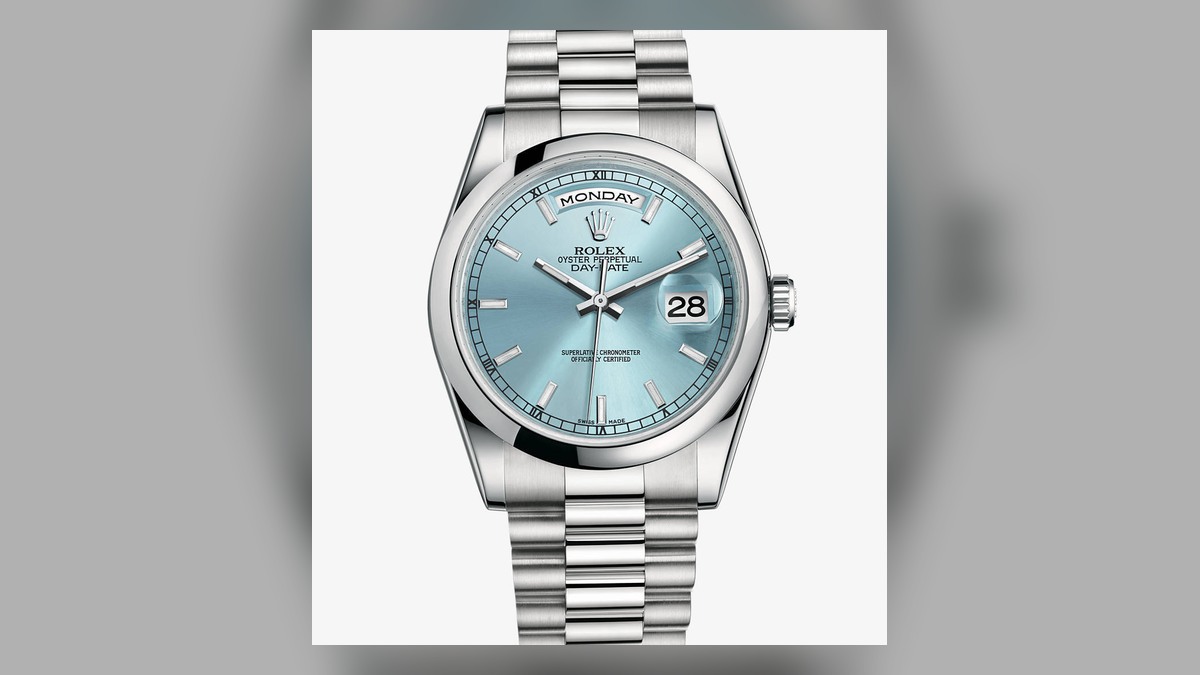
Official example: Rolex Day-Date 40 reference 228235.
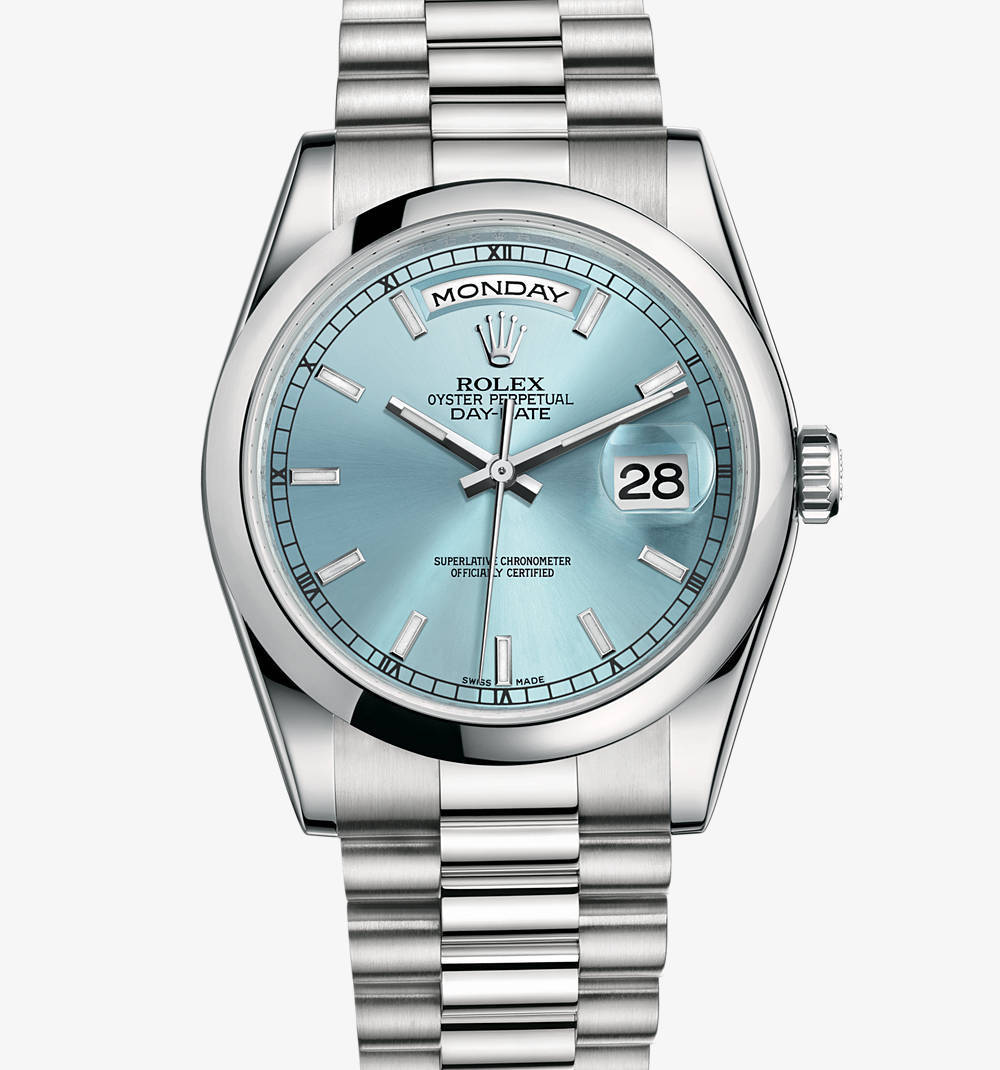
Visual size depends on bezel width, lug length, case-side height, crystal profile and the way the President-style bracelet meets the case. A thick bezel can make the dial look compressed, while long or bulky lugs increase wrist presence beyond what the diameter suggests.
Look for symmetry around the day aperture and date window, consistent minute-track spacing and a balanced relationship between the fluted bezel and dial. Use a photo taken close to perpendicular to the dial; angled marketing shots distort bezel width and lug shape.
Compare crown position, mid-case height, crystal height and the drop from lug to bracelet. An unusually tall case can indicate a movement spacer or calendar module. Again, this may be acceptable if disclosed, but it should not be marketed as identical architecture.
Rolex introduced calibre 3255 for the modern Day-Date family and publishes about 70 hours of power reserve along with instantaneous day/date functions. Replica listings may use the phrase “3255 clone” for very different movements: decorated automatic calibres, modified date movements or purpose-built day/date mechanisms.
Instead of accepting the name, ask what happens at the crown. Which position changes the day? Which changes the date? Does the movement hack? What is the measured power reserve? What frequency does it run at? Are spare calendar parts available? A movement can visually resemble a Rolex layout while using entirely different gearing underneath.
Use the Day-Date movement guide to compare 8205, 8215, 9015 and “clone” terminology.
The full weekday display should sit cleanly within the 12 o’clock aperture. On a larger dial, misalignment can be obvious because there is more open space around the text. Request photographs of several weekdays, not just one carefully selected value.
The date and Cyclops form another alignment chain: printed numeral, date aperture and magnifier centre should agree. Evaluate double-digit dates because spacing errors become easier to see. If a seller claims an instantaneous midnight switch, ask for a continuous video through the transition.
A 40 mm case gives the first bracelet links more visual weight. Check whether the end link follows the case curvature, whether the first movable link drops naturally and whether the bracelet taper looks proportional. A loose gap or abrupt step can make a technically accurate case look generic.
Rolex’s genuine President bracelet uses semi-circular three-piece links and a concealed Crownclasp. Since 2015 Rolex has also described ceramic inserts within the links of modern President bracelets. Those details provide context, but a replica bracelet should be judged by its own material disclosure, articulation, clasp operation and finishing rather than by copied marketing terms.
Day-Date 40 replicas are frequently offered with visually distinctive dials because colour attracts attention in listing photos. Ice-blue is strongly associated with platinum references; green and ombré dials appear in precious-metal configurations; diamond-style hour markers create another layer of alignment and setting quality to inspect.
Colour is difficult to judge under seller lighting. Ask for a neutral daylight or white-light image, and concentrate on printing, marker alignment, aperture placement and surface consistency before deciding whether the hue is convincing. For a broader treatment, see the dial and bezel guide.
Rolex makes the genuine Day-Date 40 only in precious metals. Replica versions can recreate the appearance with plated or coated steel and other base metals. Check the case back, inner bracelet, clasp edges and screw recesses for colour consistency. Ask the seller to separate three statements: base metal, surface treatment and claimed finish colour.
If the listing uses “904L,” “solid gold” or “platinum” as a material claim, request evidence appropriate to the claim. The materials and finishes guide explains what can and cannot be inferred from weight and colour.
If you are still choosing a size, use the Day-Date 36 vs 40 comparison.
Modern Day-Date 40 references include yellow-gold, Everose-gold, white-gold and platinum executions with a wide variety of dials. A replica does not need to copy a single catalogue reference exactly, but a listing that claims “exact reference” should keep the broad material, bezel and dial family coherent.
For example, Rolex strongly associates ice-blue dials with platinum references. A stainless-steel replica with an ice-blue dial can still be an intentional style choice, but it should not be presented as the same material construction as a genuine platinum Day-Date 40.
Larger surface areas make waviness and over-polishing easier to see. Ask for diffuse light rather than a hard point source. Harsh reflections can conceal uneven polishing. Inspect the case side as one continuous surface and check that transitions at the lugs remain deliberate rather than rounded away.
Photographs often focus on the first links because that is where the bracelet looks most substantial. Ask for a full bracelet image laid flat. The taper, link spacing and clasp width should create a coherent line. A generic bracelet can look convincing near the case yet become abruptly narrow or bulky toward the clasp.
Comparing a steel replica with a genuine platinum or gold watch by total weight is not useful. If weight matters, compare two replicas that claim the same base metal and bracelet construction. Even then, weight is a screening tool rather than proof because internal components and link design change the result.
No. Day-Date II is the earlier 41 mm large-case generation. Day-Date 40 is the later 40 mm family and should be compared to its own geometry.
Only if its actual movement provides that reserve. Seventy hours is a published genuine calibre 3255 specification, not a number that automatically applies to a replica.
No. Dial colour is a visual choice. Platinum is a material claim that requires separate evidence.