
Rolex Day-Date History & Reference Guide
A model-history guide explaining why the classic 36 mm Day-Date, 41 mm Day-Date II and modern Day-Date 40 are different reference points for replica evaluation.
A model-history guide explaining why the classic 36 mm Day-Date, 41 mm Day-Date II and modern Day-Date 40 are different reference points for replica evaluation.
A seller can use “Day-Date,” “President,” “Day-Date II” and “Day-Date 40” in one title, but those terms come from different dimensions and generations.
Editorial review: . Genuine Rolex specifications are used only as a reference baseline; replica construction, materials and water resistance must be verified separately.
Rolex dates the Day-Date launch to 1956 and describes it as the first wristwatch to combine the date with the weekday written in full in a dial window. The President bracelet was created for the model at launch. The classic identity developed around the 36 mm format before later larger versions expanded the family.
Official history: Rolex history 1953–1967.
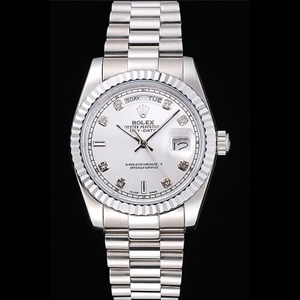
The weekday aperture at 12 o’clock is more than a decorative feature; it creates a mechanical and typographic challenge. Replica evaluation should therefore treat the day disc as a core component rather than a secondary complication.
Many vintage and later Day-Date generations use the 36 mm scale that buyers still associate with the traditional “President” look. Current Rolex Day-Date 36 watches use calibre 3255, but older genuine generations used different calibres and case references. A replica labelled simply “36 mm President” may therefore borrow design cues from several eras.
The Day-Date II introduced a substantially larger case and should not be confused with Day-Date 40. Replica listings sometimes blur the names because both are larger than the classic 36 mm watch. A 41 mm Day-Date II-style case has its own bezel, lug and dial proportions.
See the dedicated Day-Date II replica guide.
The current Day-Date 40 uses a 40 mm case and calibre 3255. It is a separate design generation rather than a one-millimetre rename of Day-Date II. A replica intended to copy Day-Date 40 should be judged against 40 mm geometry and contemporary bracelet integration, not against the older 41 mm case.
A reference number anchors a configuration to a period, size, material and design vocabulary. For replica buyers, it helps identify obvious mixtures—for example a modern dial paired with an older-style case while the listing claims exact reference fidelity.
You do not need to memorize every Rolex reference. Instead, ask the seller which genuine model inspired the replica, then check that the broad case size, bracelet, bezel and dial type belong to the same family.
Rolex created the President bracelet for the Day-Date and today reserves it for Day-Date and certain precious-metal Datejust configurations. In replica listings, “President” can be used loosely for any semi-circular three-piece bracelet. The dedicated President bracelet guide focuses on construction rather than naming.
The goal of this history guide is not to certify a watch as genuine. It is to choose the correct design baseline so that replica-specific QC has meaning. Once you know the intended generation, move to the 36 mm guide, 40 mm guide or Day-Date II guide.
Across generations, the recognizable formula remains a full weekday at 12, date at 3 and a formal precious-metal identity closely associated with the President bracelet. Case dimensions, movements, dial details and bracelet construction evolved around that formula.
Many replica designs are not strict copies of a current catalogue watch. They borrow the compact 36 mm proportions associated with older Day-Date generations, then add a modern dial colour or contemporary bracelet finishing. That can be an intentional hybrid rather than a manufacturing error, but it should not be marketed as a perfect copy of one reference.
The 41 mm generation changed more than diameter. Its bezel, lugs and visual mass created a noticeably different profile. When comparing a replica to Day-Date II, use photographs and dimensions of that generation rather than shrinking or enlarging a Day-Date 40 image.
The later 40 mm family established a new contemporary reference with calibre 3255. Current Rolex technical pages provide reliable baselines for case size, movement functions, power reserve and bracelet type, making Day-Date 40 easier to fact-check than vague replica labels.
The Day-Date has long been a platform for distinctive colours, languages, decorative stones and gem settings. A surprising dial therefore is not automatically historically impossible. The correct approach is to identify the intended genuine inspiration and compare the broad generation, material and dial family together.
Rolex has emphasized the Day-Date’s multilingual weekday display for decades. This matters for replicas because language discs are not merely translated text; each word must fit the same mechanical aperture and maintain consistent alignment.
Rolex states that the President bracelet was created for the Day-Date at its 1956 launch.
In replica-market language, no. Sellers may use “President” loosely for a bracelet style. Model identification should use the dial functions and case reference, not the bracelet nickname alone.
No. Movement choice should reflect the product’s actual design and service goals. A seller should simply describe the movement accurately rather than borrowing specifications from a different genuine generation.