
Rolex Day-Date Replica Movement Guide
A function-first comparison of MIYOTA 8205, 8215, 9015 and “clone 3255” claims, with emphasis on day/date architecture, crown operation and serviceability.
A function-first comparison of MIYOTA 8205, 8215, 9015 and “clone 3255” claims, with emphasis on day/date architecture, crown operation and serviceability.
The Day-Date needs two calendar outputs. That immediately makes movement verification more important than on a simple three-hand watch.
Editorial review: . Genuine Rolex specifications are used only as a reference baseline; replica construction, materials and water resistance must be verified separately.
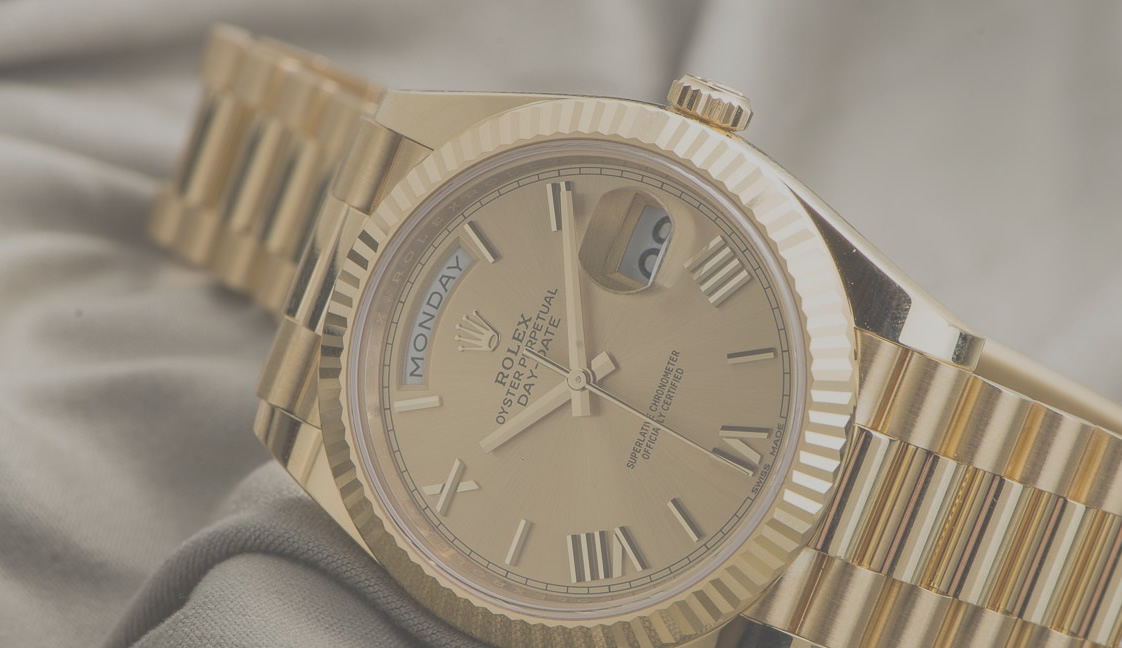
Rolex equips the current genuine Day-Date 36 and 40 with calibre 3255 and publishes an approximately 70-hour power reserve, instantaneous day/date indications and stop-seconds. Replica watches may use very different architectures. A decorative rotor or bridge layout can imitate the appearance of a Rolex movement while the functional base remains unrelated.
Official reference: Rolex Day-Date calibre 3255 overview.
| Calibre | Native calendar | Frequency | Published running time | Key Day-Date question |
|---|---|---|---|---|
| MIYOTA 8205 | Day + date | 21,600 vph | Approx. 42 hours | How is the native day display adapted to a full-width 12 o’clock aperture? |
| MIYOTA 8215 | Date only | 21,600 vph | Approx. 42 hours | What extra mechanism creates the weekday display? |
| MIYOTA 9015 | Date only | 28,800 vph | Approx. 42 hours | How is a day module added, and does it affect hand or case height? |
The 8205 already drives both calendar indications, which makes it mechanically plausible as a base for a Day-Date-style watch. But the stock architecture does not automatically place a full weekday word in the exact Rolex-style aperture at 12 o’clock. Adaptation still matters. Ask how the day disc is transferred or modified, whether the day can be quick-set and how reliably the conversion is serviced.
If a watch displays both weekday and date while the seller names an 8215 or 9015, there must be an added day mechanism or the movement description is incomplete. This is one of the most useful fact checks available to a buyer because MIYOTA’s own specifications are public.
The 9015’s higher frequency can make the seconds hand appear smoother than a 21,600 vph movement, but beat rate alone does not establish better calendar engineering. A complicated conversion can introduce additional parts, friction and service challenges.
There is no universal industry specification behind that marketing phrase. Different sellers can use it for movements with different levels of visual decoration, calendar architecture and parts compatibility. Ask for a clear case-back or movement photograph, exact crown functions, frequency, measured power reserve and whether an independent watchmaker can obtain parts.
Do not assume “clone” means genuine-compatible components. If a seller claims interchangeability with Rolex parts, that is a specific technical claim that should be supported separately.
Request one continuous video beginning with the crown fully secured, then moving through each setting position. The video should show winding, date adjustment, day adjustment if available, time setting and whether the seconds hand stops. This reveals functional architecture that decorative plates cannot hide.
Ask for a video from shortly before midnight until both displays finish changing. Some movements change gradually, some stage the day and date separately and some use a faster switching mechanism. None of those behaviours should be misrepresented. The goal is to understand what you are buying, not to force every replica to behave exactly like calibre 3255.
If a seller quotes 70 hours because the genuine 3255 has approximately that reserve, ask how the replica figure was measured. Wind the watch fully, note the time and allow it to run without additional motion. A measured result is more meaningful than a catalogue number.
A visually elaborate movement may be a poor daily-wear choice if calendar parts are unavailable or if local watchmakers will not service it. A common base movement with a straightforward conversion can sometimes be easier to maintain. Ask about replacement movement cost, calendar-module availability and whether a movement swap is possible without replacing the dial or hands.
Calendar-specific inspection continues in the Day-Date calendar guide.
An added weekday mechanism can alter the height of the dial, hand stack and stem relationship. If the conversion sits above a date-only base movement, the manufacturer may need a taller cannon pinion, extra movement ring or modified case. That is why movement architecture can become visible through external thickness and crown position.
After a calendar conversion, hands need enough vertical clearance to avoid touching each other, the dial or the underside of the crystal. Request a shallow-angle macro photo if the hour, minute and seconds hands appear unusually separated. Contact may show up as intermittent stopping rather than an obvious visual defect.
Every base calibre has a defined stem position. Adapting it to a case designed around another architecture can require a movement spacer or changes to case geometry. A crown that sits visibly high or low relative to the mid-case can therefore provide an external clue to the internal adaptation.
A seller may quote one daily-rate number measured dial-up on a timing machine. Real wrist performance varies with position, winding state and regulation. If accuracy matters, ask for timing information in more than one position and then measure the watch over several days after delivery.
A watch with a nominally adequate power reserve can still stop on the wrist if automatic winding is inefficient or the rotor is obstructed by decorative components. A rotor video can reveal obvious scraping. Daily-wear testing after delivery is more useful than relying only on a fully hand-wound reserve test.
Even when the base movement is robust, an added day module may contain thin gears or transfer parts that are less tolerant of impact. If a watch is dropped and the weekday begins changing incompletely, stop forcing the quick-set and have the calendar inspected.
Mechanical calendars can have periods when the change mechanism is already engaged. Do not assume the setting instructions for genuine calibre 3255 apply to a modified replica movement. Ask for instructions for the installed calibre and avoid forcing the quick-set if the crown shows unusual resistance.
A listing often proves only the first level with photographs while implying all three. Ask which level is actually claimed.
No. It changes seconds-hand cadence and can influence design trade-offs, but reliability, regulation, calendar engineering and serviceability matter just as much.
No. Rotor decoration is an external visual feature and can be added to an unrelated base movement.
If long-term service is important, common bases can be attractive because parts and replacement movements may be easier to source. The calendar conversion still needs its own support.